Databricks
Genie & Agent Bricks do zero [2] - A família Genie: Spaces, Agents, One, Code e Ontology
Genie & Agent Bricks from scratch [2] - The Genie family: Spaces, Agents, One, Code and Ontology
![Genie & Agent Bricks do zero [2] - A família Genie: Spaces, Agents, One, Code e Ontology](/images/genie-tipos-1.png)
Fala dataholics! Seguindo a série Genie & Agent Bricks do zero, essa é a parte 2. No post anterior a gente viu o que é o AI/BI Genie e como ele faz text-to-SQL governado sobre o Unity Catalog. Agora vamos abrir o capô de uma coisa que confunde muita gente: quando falamos "Genie", estamos falando de uma família inteira de produtos, não só da caixinha de perguntas.
No Data + AI Summit 2026 o Databricks organizou o Genie em vários membros, cada um pra um trabalho diferente. Bora ver quem é quem e, principalmente, quando usar cada um na prática.
O que veremos nesse post:
Genie Spaces: a base
Genie Agents: a evolução dos Spaces
Genie One: o coworker de negócio
Genie Code: a engenharia autônoma
Genie Ontology: o cérebro de contexto
ZeroOps, API e MCP
Qual Genie usar em cada caso
Genie Spaces: a base de tudo
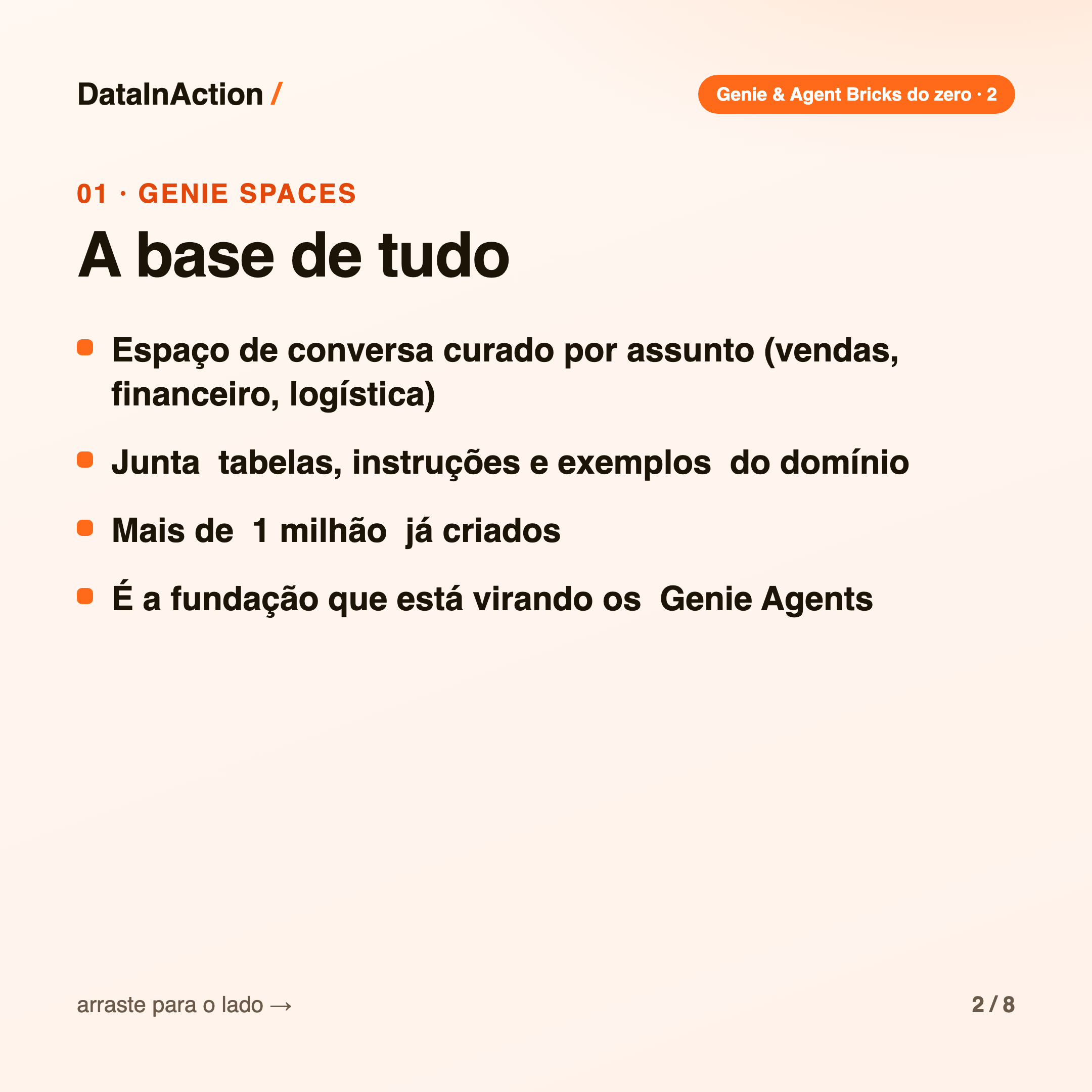
O Genie Space é a unidade fundamental. Pensa nele como um espaço de conversa curado e focado em um assunto: um Space de vendas, um de financeiro, um de logística. Dentro dele moram as tabelas daquele domínio, mais as instruções e os exemplos que ensinam o Genie a responder direito. Já passaram de 1 milhão de Spaces criados, e é justamente essa fundação que está evoluindo para os Genie Agents.
Genie Agents: sua conversa vira um agente
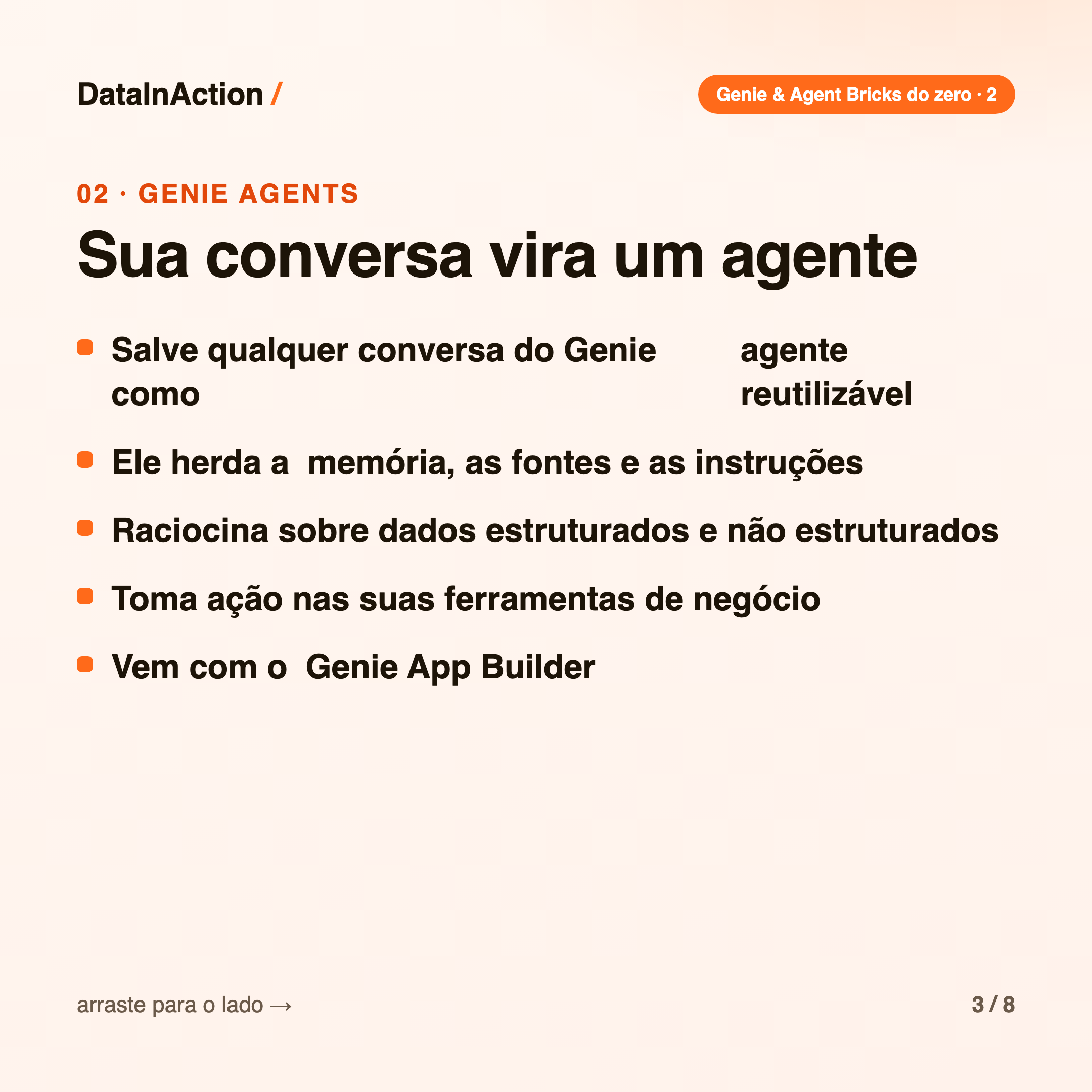
Bom, aqui mora a sacada nova. Em vez de toda conversa ser descartável, você salva uma conversa boa do Genie como um agente reutilizável. Esse agente herda a memória, as fontes e as instruções daquela conversa, então o time inteiro chama ele pelo nome e repete o fluxo sem reconstruir nada. Eles raciocinam sobre dados estruturados e não estruturados e ainda tomam ação nas suas ferramentas de negócio. Pra montar tudo isso, tem o Genie App Builder.
Reginaldo, então o Genie Agent é o que antes era o Genie Space?
É a evolução dele. O Space era uma conversa com escopo num assunto. O Agent pega essa ideia e transforma num agente reutilizável que também toma ação, não fica só respondendo.
Genie One: o coworker agêntico
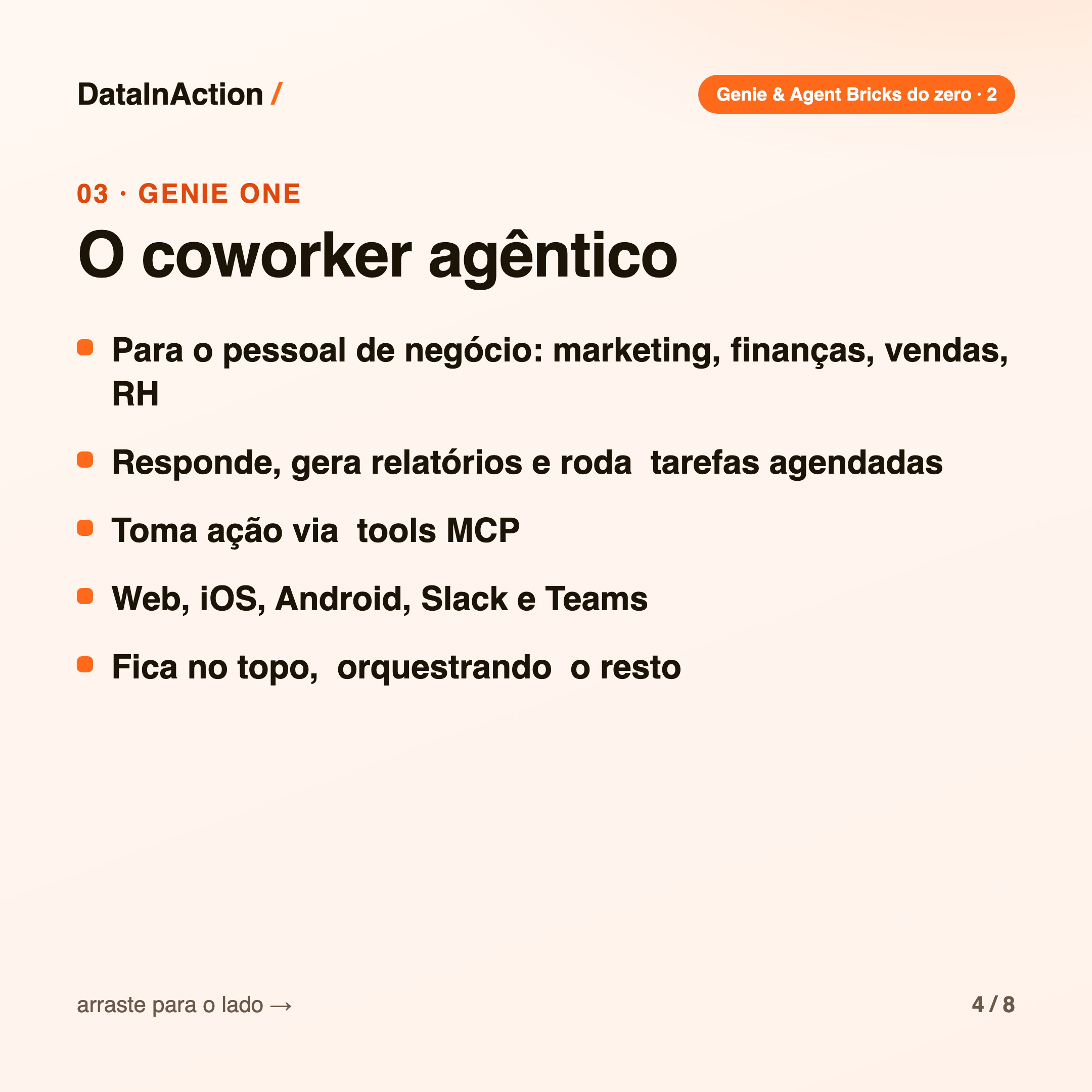
O Genie One é o Genie virado pro pessoal de negócio: marketing, finanças, vendas, RH. Ele não só responde pergunta, ele produz documentos e relatórios, roda tarefas agendadas e toma ação usando tools via MCP. E te encontra onde você já trabalha: web, iOS, Android, Slack e Microsoft Teams. Na prática, o Genie One fica no topo orquestrando os outros membros da família.
Genie Code: a engenharia de dados autônoma
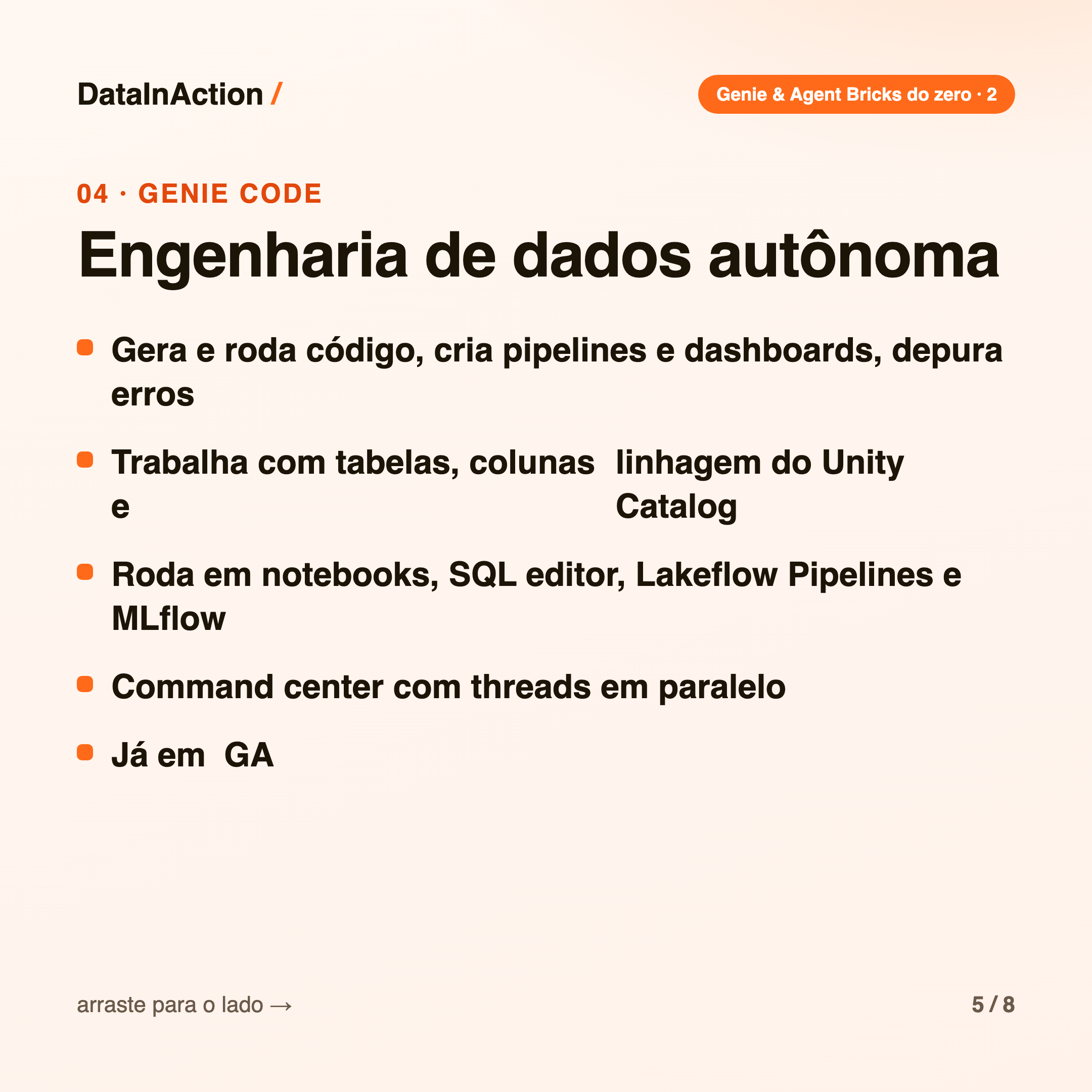
Esse aqui é o nosso lado, dataholics. O Genie Code é o parceiro de IA pra quem constrói: ele gera e roda código, cria pipelines e dashboards, depura erros e trabalha direto com as tabelas, colunas e linhagem do Unity Catalog. Ele vive dentro do workspace, nos notebooks, no SQL editor, no Lakeflow Pipelines Editor, nos AI/BI Dashboards e no MLflow, com um command center pra rodar várias threads em paralelo. E já está em GA.
Genie Ontology: o cérebro no centro
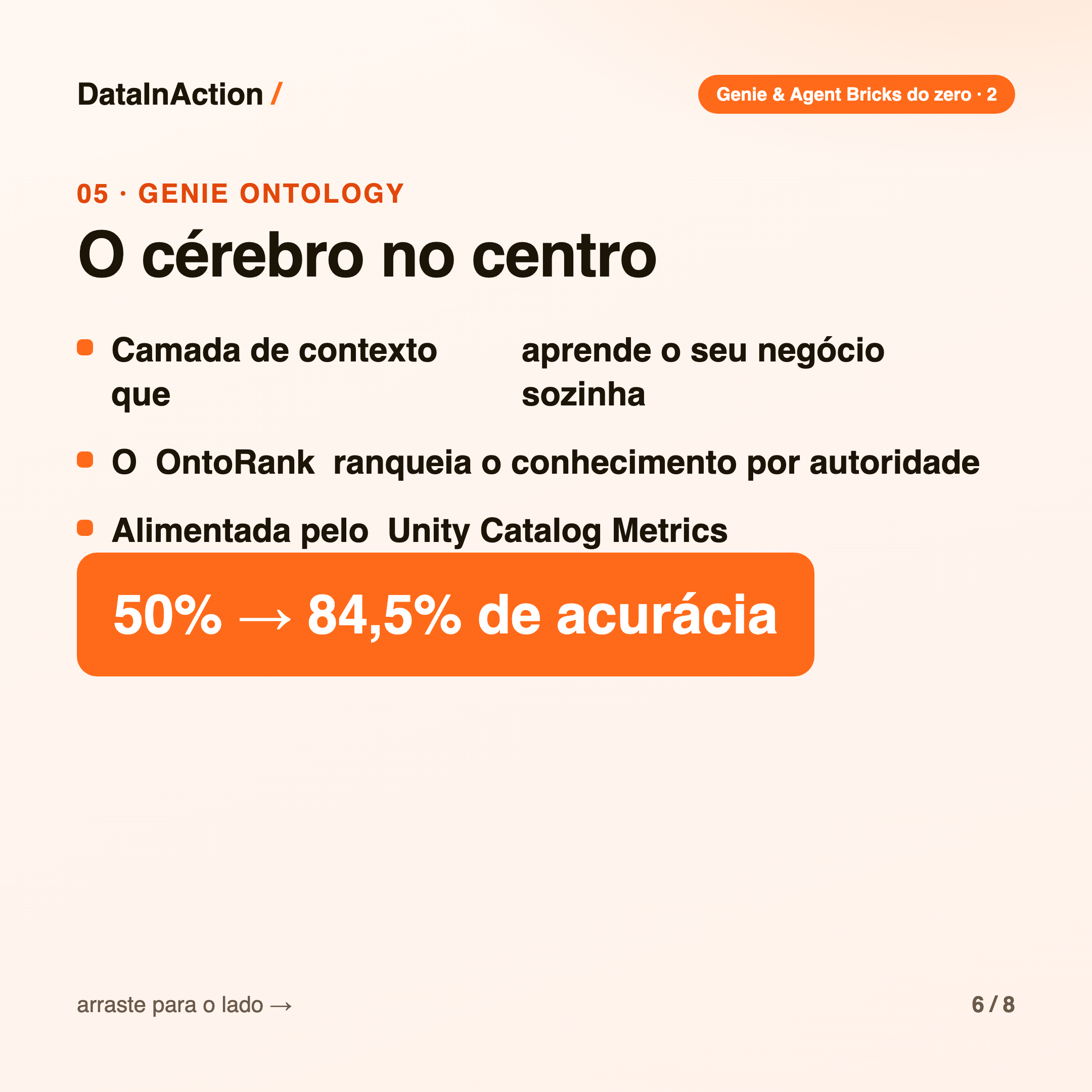
Falei dele no post anterior, mas ele merece lugar de honra porque é o que faz todos os outros responderem melhor. O Genie Ontology é uma camada de contexto que aprende o seu negócio sozinha e usa o OntoRank pra confiar na definição mais autoritativa, não na que casa por acaso com o texto. Ele é alimentado pelo Unity Catalog Metrics, onde você define os KPIs uma vez. O efeito aparece no número: nos testes do Databricks, a acurácia subiu de 50% para 84,5% com o contexto aplicado. Salto e tanto.
E ainda tem mais: ZeroOps, API e MCP
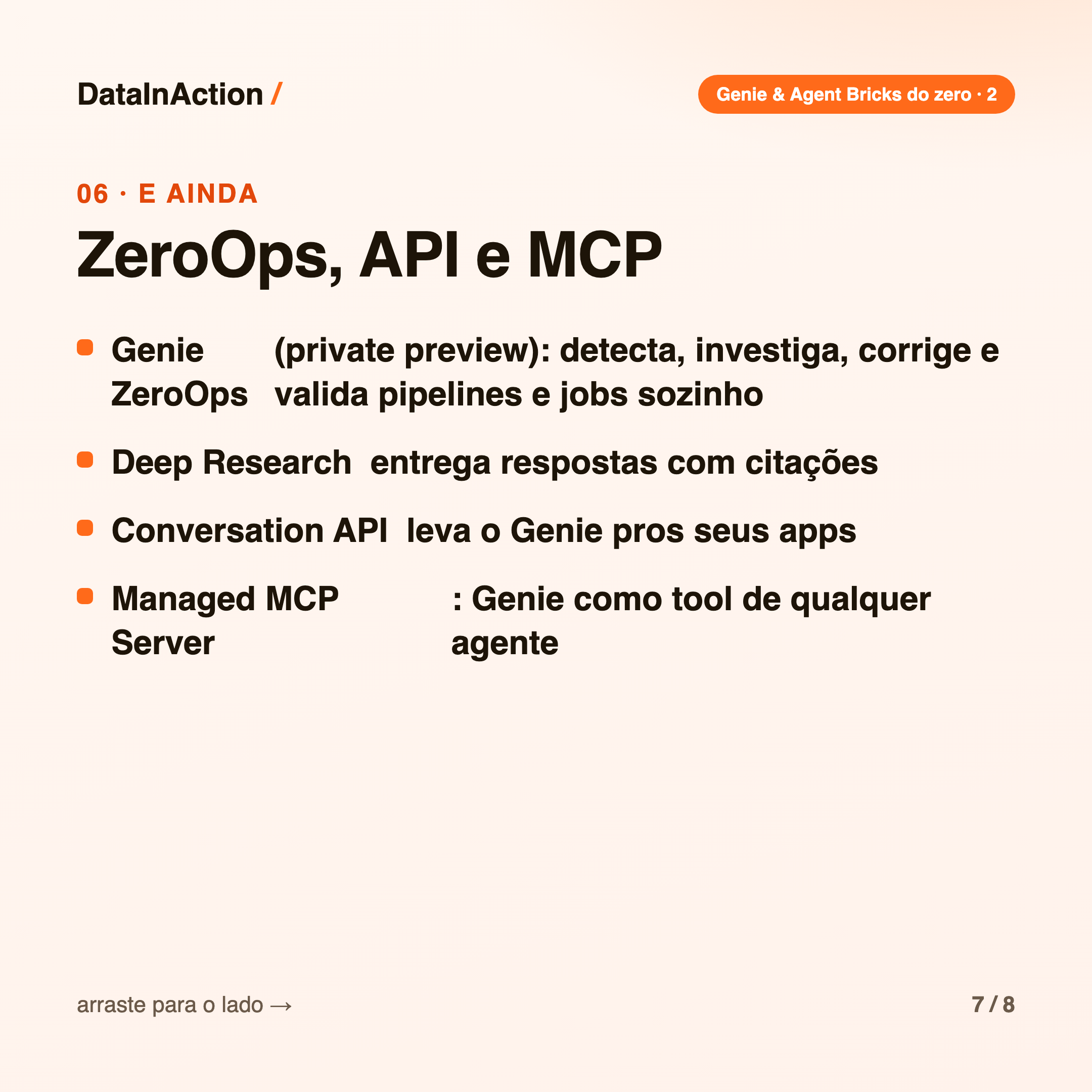
A família não para por aí. O Genie ZeroOps (em private preview) é um agente que fica monitorando seus pipelines, jobs e tabelas. Quando algo quebra, ele detecta, investiga usando a linhagem do Unity Catalog, propõe a correção e ainda valida num sandbox seguro antes de sugerir. O Deep Research entrega respostas mais profundas e com citações. E pra integrar tudo isso fora do Databricks você tem a Conversation API (pra levar o Genie pros seus apps) e o Managed MCP Server (pra expor o Genie como tool de qualquer agente).
Qual Genie usar em cada caso
Pra fechar, o resumo prático que eu uso de bússola:
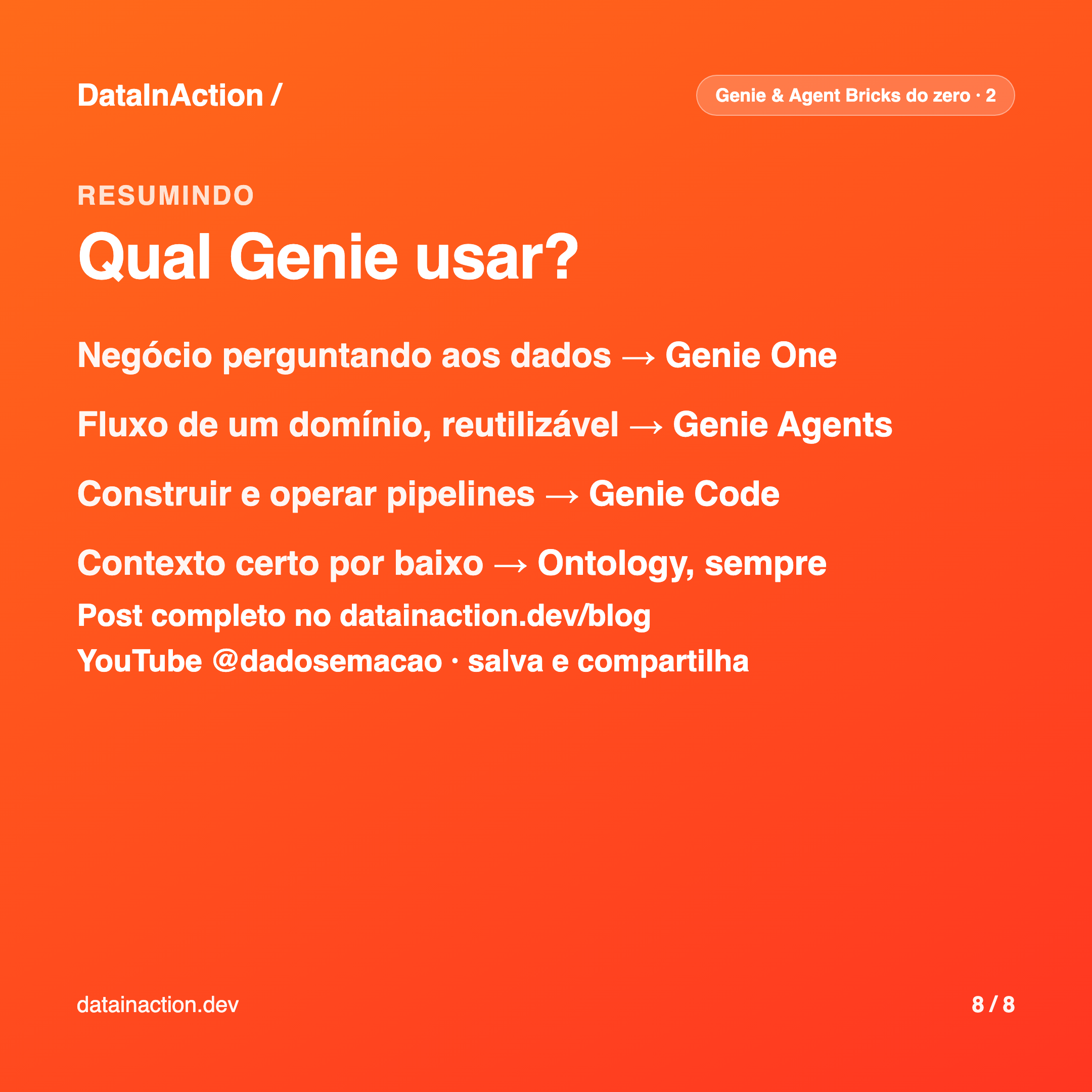
Pessoa de negócio perguntando aos dados: Genie One.
Um fluxo de um domínio que vira reutilizável pro time: Genie Agents (em cima de um bom Space).
Construir, depurar e operar pipelines: Genie Code.
Operação no piloto automático: Genie ZeroOps.
O contexto certo por baixo de todos eles: Genie Ontology, sempre.
RESUMO
Genie Spaces: base curada por assunto, está virando Genie Agents.
Genie Agents: conversa salva como agente reutilizável que age, com App Builder.
Genie One: coworker agêntico pro negócio, em Slack, Teams e mobile.
Genie Code: engenharia autônoma dentro do workspace, já em GA.
Genie Ontology: contexto que aprende o negócio e levou a acurácia de 50% para 84,5%.
Extras: Genie ZeroOps, Deep Research, Conversation API e Managed MCP Server.
Sem dúvidas, entender quem é quem na família Genie já te coloca na frente. No próximo post da série a gente parte pra prática: como curar um Genie Space de alta qualidade pra ele responder certo.
Referências:
https://www.databricks.com/blog/introducing-genie-one-genie-ontology-and-genie-agents
https://www.databricks.com/blog/introducing-genie-code
https://www.databricks.com/blog/introducing-genie-zeroops
https://www.databricks.com/blog/unifying-data-and-governance-agentic-era-whats-new-azure-databricks
Fique bem e até a próxima.
#databricks #datainaction #genie #azuredatabricks #genieone #geniecode #unitycatalog #ia
Hey dataholics! Continuing the Genie & Agent Bricks from scratch series, this is part 2. In the previous post we saw what AI/BI Genie is and how it does governed text-to-SQL over Unity Catalog. Now let's open the hood on something that confuses a lot of people: when we say "Genie", we're talking about a whole family of products, not just the little question box.
At the Data + AI Summit 2026 Databricks organized Genie into several members, each for a different job. Let's see who's who and, most importantly, when to actually use each one.
What we'll cover in this post:
Genie Spaces: the foundation
Genie Agents: the evolution of Spaces
Genie One: the business coworker
Genie Code: autonomous engineering
Genie Ontology: the context brain
ZeroOps, API and MCP
Which Genie to use in each case
Genie Spaces: the foundation of everything
The Genie Space is the fundamental unit. Think of it as a curated conversation space focused on a single subject: a sales Space, a finance one, a logistics one. Inside it live the tables of that domain, plus the instructions and examples that teach Genie to answer correctly. Over 1 million Spaces have already been created, and it's precisely this foundation that is evolving into Genie Agents.
Genie Agents: your conversation becomes an agent
Alright, here's the new twist. Instead of every conversation being throwaway, you save a good Genie conversation as a reusable agent. This agent inherits the memory, the sources and the instructions from that conversation, so the whole team calls it by name and repeats the flow without rebuilding anything. They reason over structured and unstructured data and even take action in your business tools. To build all of this, there's the Genie App Builder.
Reginaldo, so a Genie Agent is what used to be the Genie Space?
It's the evolution of it. The Space was a conversation scoped to a subject. The Agent takes that idea and turns it into a reusable agent that also takes action, not just answering.
Genie One: the agentic coworker
The Genie One is Genie turned toward business people: marketing, finance, sales, HR. It doesn't just answer questions, it produces documents and reports, runs scheduled tasks and takes action using tools via MCP. And it meets you where you already work: web, iOS, Android, Slack and Microsoft Teams. In practice, Genie One sits at the top orchestrating the other members of the family.
Genie Code: autonomous data engineering
This one right here is our side, dataholics. The Genie Code is the AI partner for those who build: it generates and runs code, creates pipelines and dashboards, debugs errors and works directly with the tables, columns and lineage of Unity Catalog. It lives inside the workspace, in notebooks, in the SQL editor, in the Lakeflow Pipelines Editor, in AI/BI Dashboards and in MLflow, with a command center to run several threads in parallel. And it's already in GA.
Genie Ontology: the brain at the center
I talked about it in the previous post, but it deserves a place of honor because it's what makes all the others answer better. The Genie Ontology is a context layer that learns your business on its own and uses OntoRank to trust the most authoritative definition, not the one that happens to match the text. It's fed by Unity Catalog Metrics, where you define the KPIs once. The effect shows up in the numbers: in Databricks' tests, accuracy went from 50% to 84.5% with context applied. Big jump.
And there's more: ZeroOps, API and MCP
The family doesn't stop there. The Genie ZeroOps (in private preview) is an agent that keeps monitoring your pipelines, jobs and tables. When something breaks, it detects it, investigates using Unity Catalog lineage, proposes the fix and even validates it in a safe sandbox before suggesting it. The Deep Research delivers deeper answers with citations. And to integrate all of this outside Databricks you have the Conversation API (to bring Genie into your apps) and the Managed MCP Server (to expose Genie as a tool for any agent).
Which Genie to use in each case
To wrap up, the practical summary I use as a compass:
Business person asking the data questions: Genie One.
A domain flow that becomes reusable for the team: Genie Agents (on top of a good Space).
Building, debugging and operating pipelines: Genie Code.
Operations on autopilot: Genie ZeroOps.
The right context underneath all of them: Genie Ontology, always.
RECAP
Genie Spaces: curated foundation by subject, turning into Genie Agents.
Genie Agents: conversation saved as a reusable agent that acts, with App Builder.
Genie One: agentic coworker for the business, on Slack, Teams and mobile.
Genie Code: autonomous engineering inside the workspace, already in GA.
Genie Ontology: context that learns the business and took accuracy from 50% to 84.5%.
Extras: Genie ZeroOps, Deep Research, Conversation API and Managed MCP Server.
No doubt, understanding who's who in the Genie family already puts you ahead. In the next post of the series we go hands-on: how to curate a high-quality Genie Space so it answers correctly.
References:
https://www.databricks.com/blog/introducing-genie-one-genie-ontology-and-genie-agents
https://www.databricks.com/blog/introducing-genie-code
https://www.databricks.com/blog/introducing-genie-zeroops
https://www.databricks.com/blog/unifying-data-and-governance-agentic-era-whats-new-azure-databricks
Take care and see you next time.
#databricks #datainaction #genie #azuredatabricks #genieone #geniecode #unitycatalog #ai
Gostou? Tem mais no YouTube e no LinkedIn.
Enjoyed it? There's more on YouTube and LinkedIn.
Continue lendo Keep reading
![Genie & Agent Bricks do zero [1] - O que é o AI/BI Genie e como ele funciona sobre o Unity Catalog](/images/genie-do-zero-1-capa.png)
Genie & Agent Bricks do zero [1] - O que é o AI/BI Genie e como ele funciona sobre o Unity Catalog
Ler → Read →
Observabilidade do Azure Databricks - System Tables lakeflow - Monitoramento de Jobs #2
Ler → Read →