IA & Agentes
Copilot Studio - Copilot Credits - o agente começa a cobrar antes de você publicar
Copilot Studio - Copilot Credits - the agent starts billing before you publish
Fala dataholics, ontem eu abri o que é o harness do Copilot Studio e deixei uma linha pra hoje, a da cobrança. É a parte que mais gente vai levar susto, porque no GitHub Copilot harness o crédito começa a rodar bem antes de o agente ir pro ar.
O que veremos nesse post:
O que é o Copilot Credit e o que consome crédito
A mudança que pega todo mundo, a cobrança durante o build
A data que você precisa anotar
Onde acompanhar o consumo
Cobrança por uso, medida em Copilot Credits
Agente, workflow e app que rodam no GitHub Copilot harness saíram do modelo de licença e entraram em cobrança por consumo, medida em Copilot Credits. Quanto o seu agente gasta depende de como ele foi desenhado, da frequência com que as pessoas conversam com ele e das features que ele usa.
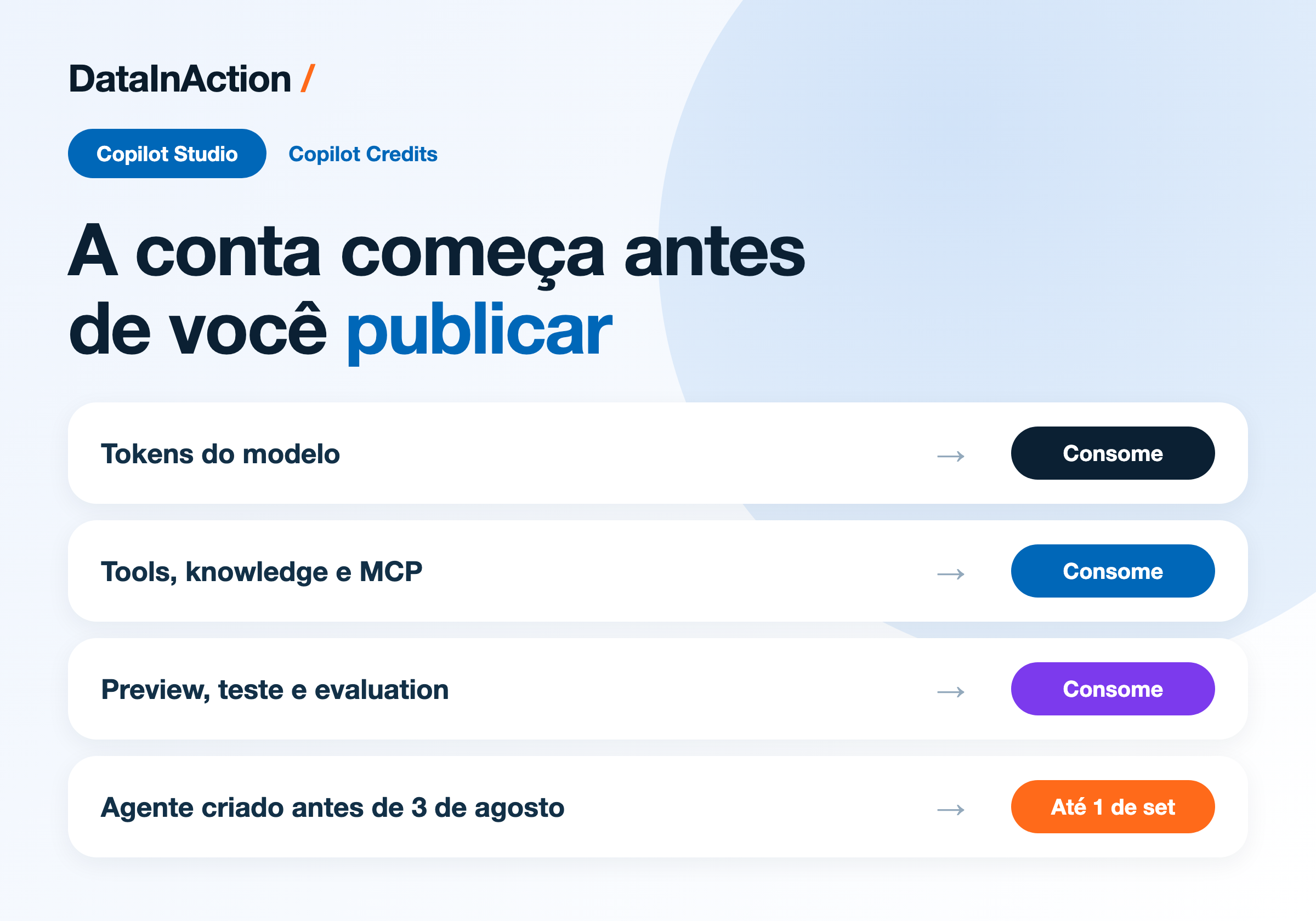
E o crédito não cobre só o token do modelo. Segundo a documentação, ele é cobrado por três coisas:
Tokens do LLM, o que já era esperado.
Tools, e aqui entram também knowledge e servidores MCP.
O próprio harness, ou seja o runtime que orquestra tudo.
Repara no segundo item, porque ele muda o desenho do agente. Cada fonte de knowledge que o orquestrador resolve consultar e cada chamada de MCP entram na conta. Aquele agente com oito fontes plugadas "por via das dúvidas" agora tem um preço, e vale revisar se todas elas precisam mesmo estar lá.
A pegadinha: a conta começa no build
Essa é a diferença que muda rotina. No Standard harness a cobrança começa depois que você publica, então o ambiente de desenvolvimento era de graça e a gente testava à vontade. No GitHub Copilot harness o crédito é debitado desde o momento em que você começa a construir.
A doc é bem específica sobre o que consome:
Criar uma solução automatizada descrevendo o que você quer em linguagem natural.
Fazer preview e testar o agente.
Gerar e rodar evaluation.
Aquele ciclo de ajustar a instrução, testar, não gostar, ajustar de novo, que é exatamente o que eu fiz na série de 40% a 90% com Evaluation, agora tem custo em cada volta. Eu rodei aquele test set umas quantas vezes seguidas pra achar o que estava quebrando, e se fosse hoje nesse harness eu teria pensado duas vezes antes de disparar a bateria inteira só pra conferir uma frase da instrução.
Reginaldo, então evaluation ficou proibido?
Nada disso, evaluation continua sendo a melhor ferramenta que você tem pra saber se o agente responde bem. O que muda é a disciplina: em vez de rodar o test set completo a cada mexida pequena, dá pra manter um subconjunto curto pro dia a dia e guardar a bateria inteira pros momentos que importam, tipo antes de publicar ou depois de uma mudança grande de instrução.
A data pra anotar
Saiu no Message Center e é fácil deixar passar. Agente criado antes de 3 de agosto de 2026 não é cobrado até 1 de setembro, e agente criado a partir de 3 de agosto já consome crédito na hora, tanto na criação quanto na execução.
Ou seja, quem passou o mês brincando com o harness novo achando que estava tudo por conta da casa vai ver o consumo aparecer na virada do mês. Se você criou coisa nesse período, vale entrar agora e olhar o que ficou ligado antes que setembro chegue.
Onde acompanhar o consumo
Tem dois lugares e cada um responde uma pergunta diferente:
Na página Monitor do agente, dentro do Copilot Studio, você vê quanto aquele agente específico consumiu.
No Power Platform admin center, em Licensing e depois Copilot Studio, você vê o consumo do ambiente inteiro e do tenant.
É no admin center também que o administrador compra o crédito e aloca por ambiente, e essa alocação por ambiente é a alavanca de controle que eu usaria primeiro. Separar dev de produção com orçamento próprio evita que uma bateria de teste mal calibrada coma o crédito do agente que está atendendo cliente.
DETALHE IMPORTANTE: a cobrança por crédito vale só pro que roda no GitHub Copilot harness. Seus agentes no Standard harness e os agent flows continuam no licenciamento de sempre, então não precisa entrar em pânico com o que já está no ar.
RESUMO
Copilot Credits é cobrança por uso e vale só pro GitHub Copilot harness.
Consomem crédito: token do modelo, tools (knowledge e MCP incluídos) e o harness.
A conta começa no build, não na publicação. Preview, teste e evaluation gastam.
Agente criado antes de 3 de agosto tem carência até 1 de setembro.
Acompanhe no Monitor do agente e no Power Platform admin center, e separe o crédito de dev do de produção.
Comenta aí se a sua área já tem alguém de olho nesse consumo, porque essa conta chegou de mansinho e cai no colo de quem cuida do ambiente.
Referências:
Overview of usage-based billing
Fique bem e até a próxima.
#copilotstudio #copilotcredits #finops #microsoft #ia #agentes #datainaction
Hey dataholics, yesterday I opened up what the Copilot Studio harness is and left one line for today, the billing one. It's the part that will catch most people off guard, because on the GitHub Copilot harness credits start burning well before the agent goes live.
What we'll see in this post:
What a Copilot Credit is and what consumes credits
The change that gets everyone, billing during the build
The date you need to write down
Where to track consumption
Usage-based billing, measured in Copilot Credits
Agents, workflows and apps running on the GitHub Copilot harness moved out of the license model and into consumption billing, measured in Copilot Credits. How much your agent spends depends on how it was designed, how often people talk to it and which features it uses.
And credits don't only cover model tokens. According to the docs, they're charged for three things:
LLM tokens, which was expected.
Tools, and this includes knowledge and MCP servers.
The harness itself, meaning the runtime that orchestrates everything.
Look closely at the second item, because it changes how you design the agent. Every knowledge source the orchestrator decides to search and every MCP call lands on the bill. That agent with eight sources plugged in "just in case" now has a price tag, and it's worth reviewing whether all of them really need to be there.
The catch: the meter starts at build time
This is the difference that changes your routine. On the Standard harness billing starts after you publish, so the development environment was free and we tested as much as we wanted. On the GitHub Copilot harness credits are debited from the moment you start building.
The docs are pretty specific about what consumes:
Creating an automated solution by describing what you want in natural language.
Previewing and testing the agent.
Generating and running evaluations.
That loop of tweaking the instruction, testing, not liking it, tweaking again, which is exactly what I did in the from 40% to 90% with Evaluation series, now costs money on every lap. I ran that test set quite a few times in a row to find what was breaking, and if it were today on this harness I'd have thought twice before firing the whole battery just to check one sentence in the instruction.
Reginaldo, so is evaluation off limits now?
Not at all, evaluation is still the best tool you have to know whether the agent answers well. What changes is the discipline: instead of running the full test set on every small tweak, you can keep a short subset for day to day work and save the full battery for the moments that matter, like right before publishing or after a big instruction change.
The date to write down
It came out in the Message Center and it's easy to miss. Agents created before August 3rd, 2026 aren't charged until September 1st, and agents created from August 3rd onward consume credits right away, both at creation and at runtime.
So anyone who spent the month playing with the new harness thinking it was all on the house will see consumption show up at the turn of the month. If you created things in that window, it's worth going in now and checking what you left switched on before September arrives.
Where to track consumption
There are two places and each one answers a different question:
On the agent's Monitor page inside Copilot Studio you see how much that specific agent consumed.
In the Power Platform admin center, under Licensing and then Copilot Studio, you see consumption for the whole environment and the tenant.
The admin center is also where the administrator buys credits and allocates them per environment, and that per environment allocation is the control lever I'd reach for first. Separating dev from production with its own budget stops a badly calibrated test run from eating the credits of the agent that's serving customers.
IMPORTANT: credit billing only applies to what runs on the GitHub Copilot harness. Your agents on the Standard harness and your agent flows stay on the usual licensing, so no need to panic about what's already live.
RECAP
Copilot Credits is usage-based billing and applies only to the GitHub Copilot harness.
Credits are consumed by: model tokens, tools (knowledge and MCP included) and the harness.
The meter starts at build time, not at publish. Preview, testing and evaluation all spend.
Agents created before August 3rd have a grace period until September 1st.
Track it on the agent's Monitor page and in the Power Platform admin center, and split dev credits from production credits.
Comment below if your team already has someone watching this consumption, because this bill arrived quietly and lands on whoever takes care of the environment.
References:
Overview of usage-based billing
Take care and see you next time.
#copilotstudio #copilotcredits #finops #microsoft #ai #agents #datainaction
Gostou? Tem mais no YouTube e no LinkedIn.
Enjoyed it? There's more on YouTube and LinkedIn.
Continue lendo Keep reading
![GitHub Copilot a fundo [5] - AI Credits: o Copilot virou usage-based](/images/ghcopilot-aicredits-capa.png)
GitHub Copilot a fundo [5] - AI Credits: o Copilot virou usage-based
Ler → Read →![GitHub Copilot a fundo [4] - Copilot CLI: o agente que mora no seu terminal](/images/ghcopilot-cli-capa.png)
GitHub Copilot a fundo [4] - Copilot CLI: o agente que mora no seu terminal
Ler → Read →![GitHub Copilot a fundo [3] - MCP: ferramentas para o agente sem perder a governança](/images/ghcopilot-mcp-capa.png)